 Borzoi
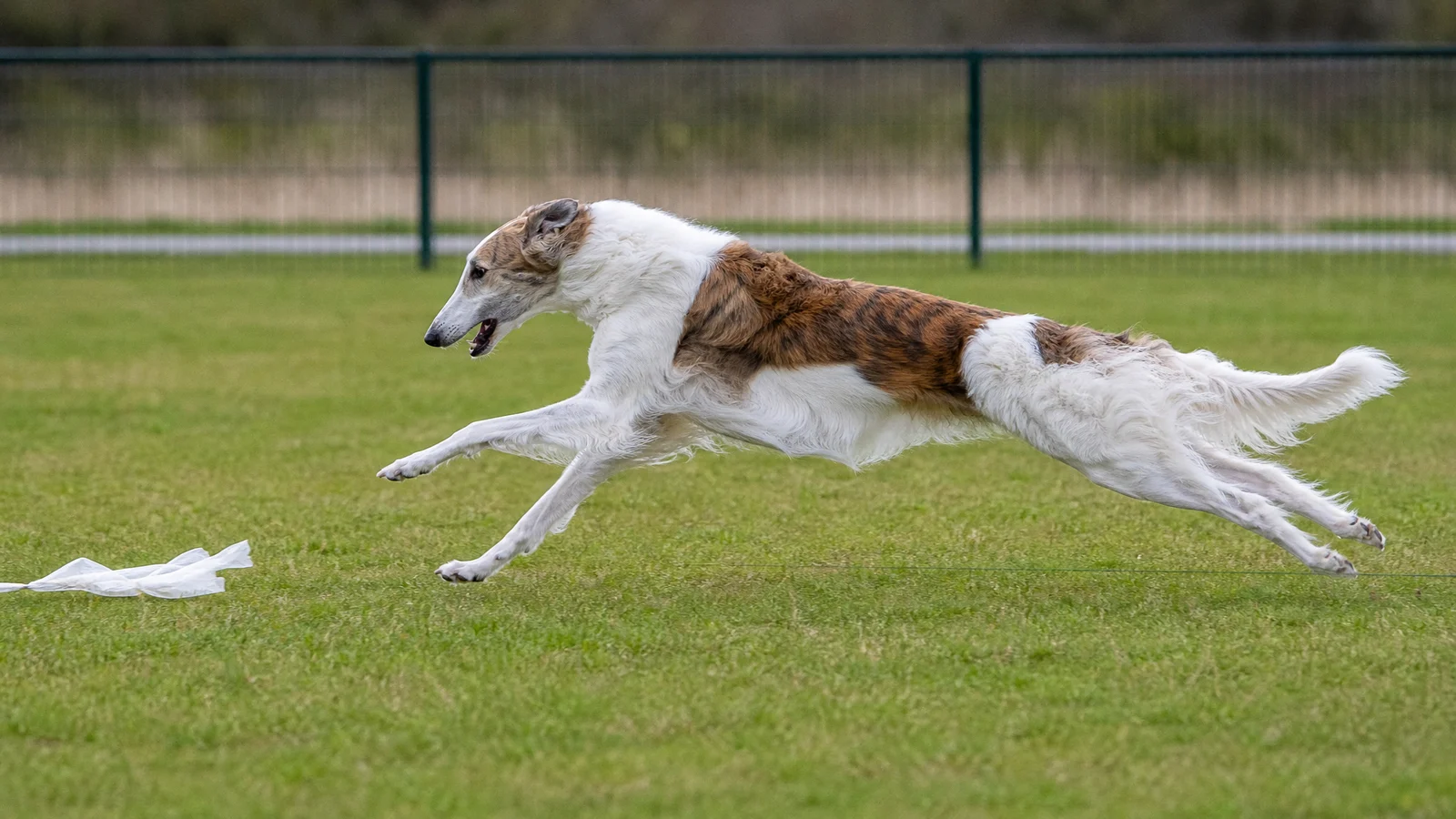
A Borzoi puppy can go to matches and practices without competing long before they run a real course. Short straight runs come next, the test that lets a young dog qualify opens at 11 months, and competition begins at 1 year. Timing is the real question for most owners, because a Borzoi is a long-limbed, slow-maturing athlete who can be set back badly by one awkward fall.
Done well, coursing gives the breed what a backyard cannot, a legitimate place to chase. Among the 89 Borzoi owners whose first-hand accounts we reviewed, many said their dog will not gallop alone, and a flirt pole or a second Borzoi is what gets them running.
We'll walk you through where the chase instinct comes from and how the sport began, then the puppy practice and bump stages, the handling skills coursing teaches, and how it all fits into daily life and the long years ahead.
Borzoi Wolf Hunting Before Lure Coursing
Before there was a sport, there was a job. The Borzoi was the favored dog for coursing wolves, large hunt kennels were set up around them, and the imperial kennels of the Czar dated back to 1613. That hunting peaked in the late nineteenth century, with Borzoi pursuing wolves, fox and hare across the Russian steppes by sight.
What the dogs did there explains nearly everything about them now. They were bred to course game over more or less open ground, relying on sight rather than scent, and to be swift and tough enough to pursue and pin a wolf.
The international standard describes a hunting sighthound and racing and coursing hound, and it notes both a calm temperament and a visual response that is well evident.
Today the quarry is a squirrel at the end of the block, a rabbit under a hedge, or a plastic bag lifting off a lawn. Movement seen at a distance is the trigger, and a Borzoi who is perfectly easy with the indoor cat can change completely outdoors when that same cat runs. We treat this as what the breed was built to do, not a habit to be trained away, so the goal is always management and a proper outlet.
Owners who trained recall from puppyhood often report that it switches off the moment the dog sees an animal, even in a dog who adores people. Many say off-leash trust differs by individual and by line, and that dogs from coursing lines stay on leash. Common advice says enough recall practice earns off-leash freedom, and for this breed we disagree. Our Borzoi recall training guide explains why a leash and a long line are the plan.
How Lure Coursing Came to Be
Lure coursing was developed in the early 1970s so sighthounds could compete without the problems of coursing live game. Lyle Gillette, a Borzoi breeder, got it going by touring the country in 1971 to demonstrate it to Borzoi owners.
A national committee formed in 1972 and grew into an organization that set rules, judging and a point and title system in 1975. Sanctioned coursing under the rules of the big all-breed registry followed in 1991, and today a Borzoi can earn titles under both systems.
The setup is simple to picture. A course is a zigzag of at least 500 yards, with pulleys staked out to form the turns and a lure of plastic strips, usually white garbage bags, pulled along a line. The machine can move the lure at up to 50 mph, and the operator tries to keep it 10 to 30 yards ahead of the hounds, stopping it if a hound tangles in the line or danger develops.
A Borzoi in full stride reaches 35 to 40 miles per hour, so the sport gives all that speed a start, a finish and a person waiting at the end. Free running on an open street offers none of those, which is why we count coursing as part of a Borzoi's training plan and not only as a hobby.
A Borzoi Puppy's First Lure Coursing Practice
The gentlest way in is to show up and not run at all. Puppies do best when you take them to matches, practices and courses where they will not compete, so they get used to the excitement and to dogs of many breeds and temperaments without any pressure.
To find a practice, contact a regional Borzoi club, attend a couple without running a dog, and ask questions. The people involved are generally glad to help newcomers. While you watch, look at your puppy rather than the field, because a good coursing prospect shows a few things:
- They are outgoing and active, and stay comfortable in a busy place.
- They get along with littermates and with adult dogs.
- They show keen interest in a lure tied to a buggy whip and try to chase and catch it.
- They have a good attention span for their age.
Keep visits fun and brief, and skip them when the puppy is tired or the weather is uncomfortable.
Growing Borzoi are often uncoordinated, and owners describe serious limb injuries from an innocent-looking knock in play. The hardest part of recovery, they say, is keeping a puppy calm and crated for weeks, with the vet setting the schedule. Some injuries need surgery and a long rehab, and a serious injury can end a sport career before it starts.
That is why puppy practice stays short and straight. A clumsy giant can also step or fall on a smaller dog, so stay close when your puppy plays with little ones.
Lure Coursing Bumps: Short, Straight, Before the Course
A bump is a brief, straight run after a lure, and it comes before any course with turns. Start with a short straight-away and bring in a lure that turns only gradually. Short straight runs are a simple way to see whether a young dog is interested before you ask for anything longer.
This table lays out the stages as the sources describe them. Dogs mature on their own schedules, so treat the ages as the earliest sensible points, not targets.
| Stage | What it looks like |
|---|---|
| Practice visits | Watching, meeting dogs and getting used to the noise, with no running required |
| Puppy bumps | Short straight runs after a lure, before courses with turns |
| Qualifying test | Possible from 11 months at a practice, one course of at least 500 yards with another hound |
| Competition | Opens at 1 year |
| Full maturity | Growth continues to 18 months and beyond, with physical maturity at about 2 years |
Between bumps, build fitness the way you would for any athlete. Begin with brisk walks and increase time and distance gradually, avoid rough surfaces such as sidewalk, check the pads often, and warm up and cool down around every session. Good conditioning, nutrition and warm-up greatly reduce the chance of injury, and a young dog who is still growing should never be over-trained.
Keep strenuous running away from mealtimes, both before and after, because deep-chested breeds can bloat. Plan practice around the feeding schedule rather than the other way around, and see your vet regularly through the growing months so small problems are caught early.
This article gives general information only. Your veterinarian is the right person to advise on your dog's feeding schedule, the signs of bloat and how much exercise suits them.
What Coursing Teaches Between Runs
The run itself needs no teaching. The skills worth your time are the ones around it, and two of them come straight from the sport: a calm release at the start and a happy pick-up at the end.
Waiting and Release at the Start
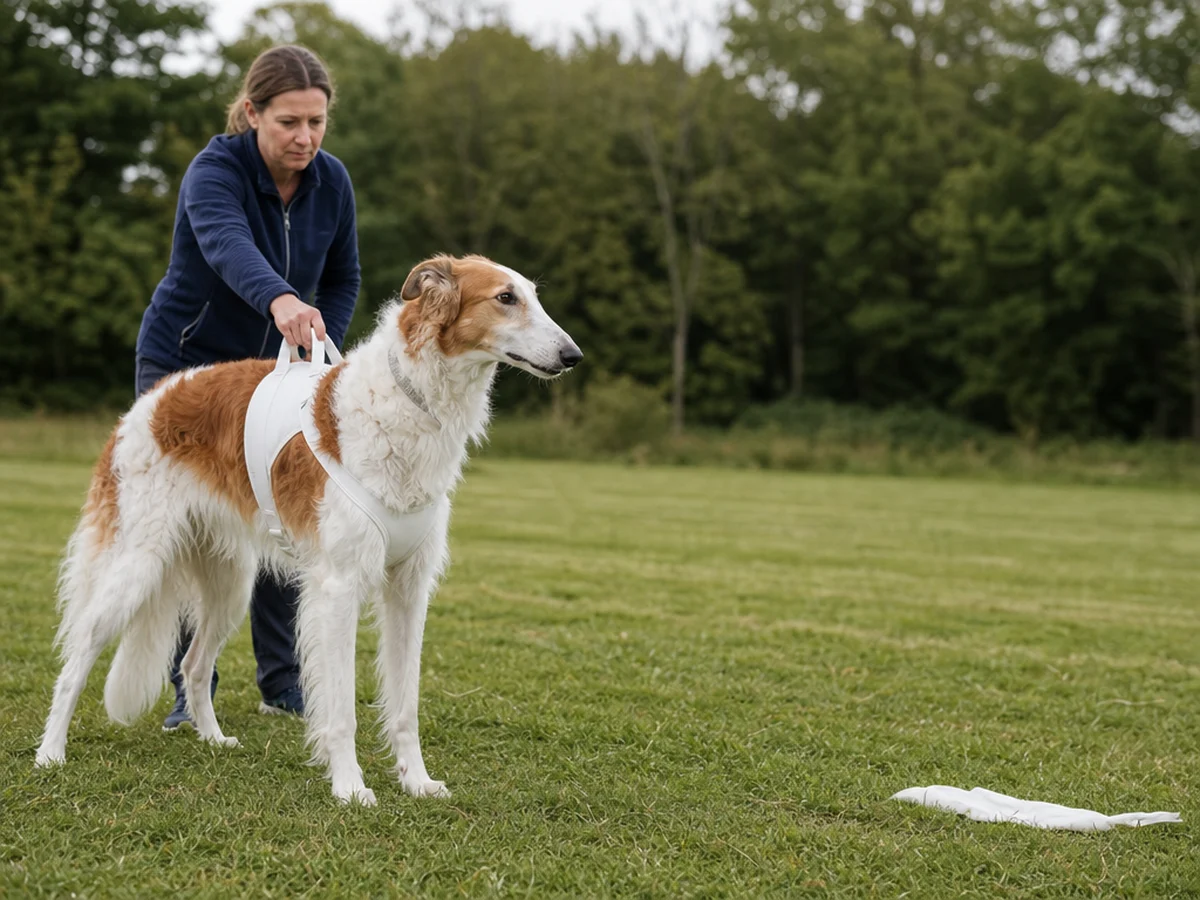
The minimum equipment is a slip leash, usually leather or webbing with a wide collar and one or two rings, and clubs commonly lend them along with coursing blankets. No other collars or gear are permitted while the hound runs. At home, pair the slip leash with treats, ask for a calm stand, and release on a cue word you use only for this. The reason is practical: a course delay is called when hounds break away before the call of Are you ready?
Being Caught After the Run
After the run comes the call Retrieve your hounds, and a delay is also called when hounds avoid their handlers then. Even at all-breed coursing ability events, some dogs did not want to be caught and the whole event came to a halt. Make the pick-up the best part of the day:
- Practice in a fenced space or on a long training lead, which gives some freedom without complete free range, and pay several treats for every approach.
- Touch the slip leash or collar while treats are still flowing, then release the dog again, so being caught often leads to more fun.
- At practices, reward at the end of the run with a favorite treat or a game of tug, and keep the mood happy.
Muzzle Comfort
Fitted muzzles are optional, but if you plan to use one, teach comfort long before race day. Feed treats through it and build the time worn slowly. Remember that a muzzle is never a punishment and a dog should never be left alone wearing one.
The same patient work pays off in the first titles. A young courser has to run alone with steady focus on the lure, and later has to run beside another hound without interfering, both of which you can build at practices. Afterward, teach a settle on a mat or blanket so the adrenaline has somewhere to go, and our guide to teaching a Borzoi to settle indoors shows how.
Fitting Fieldwork Into Everyday Life With a Borzoi
Daily exercise has two parts for this breed, walks on leash and free running, and the running can only happen in a securely fenced area. Running free for 30 minutes or more a day in a fenced space is described as the best exercise, and another national breed reference says up to an hour a day. Coursing practice adds to that routine and does not replace it.
Individuals differ more than the numbers suggest. Owners with more than one Borzoi describe very different energy in the same home: one needs daily play while the other is a couch potato, and one dog is lazy indoors while the next is lazy outdoors. Some low-energy adults and seniors do well on walks alone, even with almost no room to run.
Many owners also report that their Borzoi will not gallop on their own. Given a fenced yard or a dog park, they lie down beside non-sighthound dogs, and a flirt pole or a second Borzoi is what gets them going. So the usual advice to tire a dog out at the dog park often fails here, and in our reading a regular coursing outlet, or a flirt pole, is a better answer.
Around small animals, assume the chase can start anywhere. Being raised with other animals helps, but any small animal that runs may trigger pursuit, so keep outings on leash. Neighborhoods rich in rabbits and squirrels make walks harder.
Some owners report escapes over and through fences and gates, and doors left open by guests, so read our guide to fences, ID and a lost-dog plan. For the instinct behind other everyday problems, see common Borzoi behavior problems.
The Years Ahead for a Coursing Borzoi
Borzoi are slow to grow up, and the coursing years unfold slowly too. Sexual maturity typically arrives between 12 and 18 months, growth continues to 18 months and beyond, and physical maturity comes at about 2 years. A dog may be old enough to compete at 1 year yet still be a gangly teenager, so let the body catch up before you ask for everything the sport offers.
Through the adult years, expect the drive to persist. It may show as a dog who needs daily play, or as one who is a couch potato. Owners describe lively seniors too, some acting years younger than their age, and a new dog in the house can give an older one a second puppyhood.
Bodies still slow with time. Plan shorter, gentler sessions, keep up the warm-ups, and book regular vet visits that grow more frequent with age. Never ignore a limp that lingers or makes walking hard. Veteran classes exist for older competitors, and an owner can forfeit the Best of Breed run if the dog is tired.
Over a whole life, the arc is predictable. The drive stays, the body slows, and the role shifts from runner to fan. An older Borzoi who no longer runs may still enjoy watching the hounds, and the best way to honor that is to keep the outlet in their life, with a place at the edge of the field, a blanket and a treat in your pocket.
 Puppy trainingBorzoi Puppy Training Timeline: 8 Weeks to 2 Years
 Training basicsBorzoi Recall Training: Why Off-Leash Is Not the Goal
 Exercise and jobsBorzoi Sports and Jobs: Putting the Breed's Instincts to Work