 Borzoi
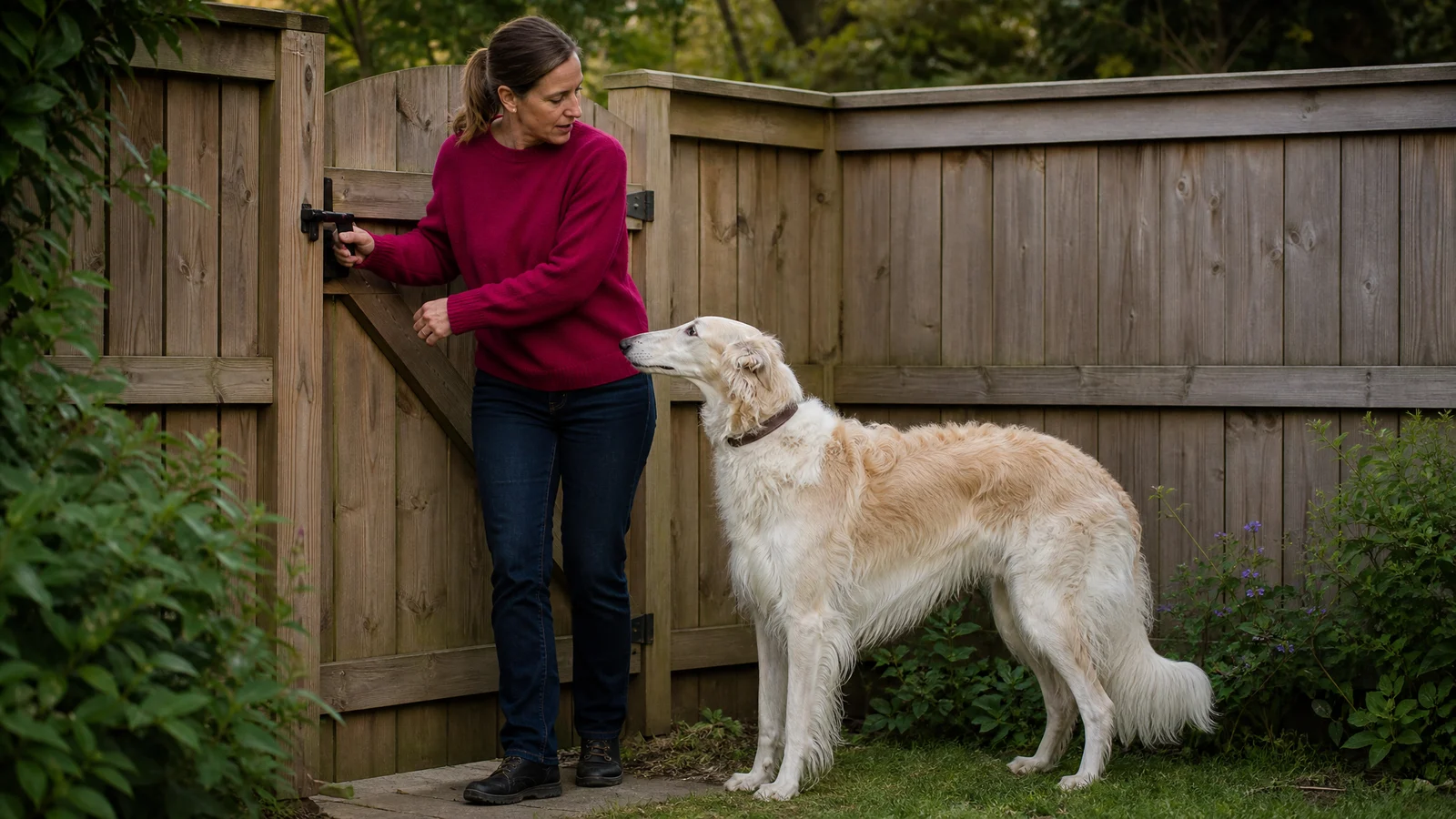
The usual advice has three parts: fence the yard, tag the dog, teach a recall. Breed material backs all three and adds a plain rule that running a Borzoi loose is never advisable.
Owners report where that plan leaks. A 6-foot fence gets jumped. Boards hidden in brush get pushed loose. A dog opens a gate, or a guest leaves the front door open. And even a solid recall from the living room switches off the moment the dog sees an animal.
Below, you'll find the fence checks, the ID and photo records, and the limits of recall, including the squeaker-and-buddy habits for a lost-dog kit and the car rule. Escape prevention is the main plan. Recall training is the backup.
What a Borzoi-Proof Fence Needs, Plus Gate Training
The first tool is space. Keep a Borzoi in a secure fenced yard or an enclosed kennel, and let hard running happen only there. No source gives a safe fence height for the breed, so do not trust a number. Owners report a 6-foot fence cleared. Treat height as a minimum, not a guarantee, and check the whole boundary, not just the tall part.
The fence is also your exercise tool. Breed guidance says Borzoi need exercise, met by running in a safe fenced yard and/or daily walks on leash. Energy varies by dog. Owners with more than one Borzoi describe one needing daily play and another being a couch potato. Low-energy adults and seniors in small yards often do well on walks alone. The full range is laid out in how much exercise a Borzoi needs.
Checking the Fence Line
Walk the whole boundary on a schedule and after every storm. Look at it the way a long, lean, fast dog would.
- Push on every board and panel, especially where brush, vines or stacked material hide the fence. Owners report hidden boards pushed loose.
- Check the bottom edge, the corners and the space beside each gate post for any gap a lean dog could squeeze through.
- Test every gate latch with a nose and a paw. Owners report dogs who opened a gate, so use a latch that needs a human hand.
- Move anything that gives a boost near the fence, such as stacked wood, furniture or a raised bed.
Doors, Gates and Guests
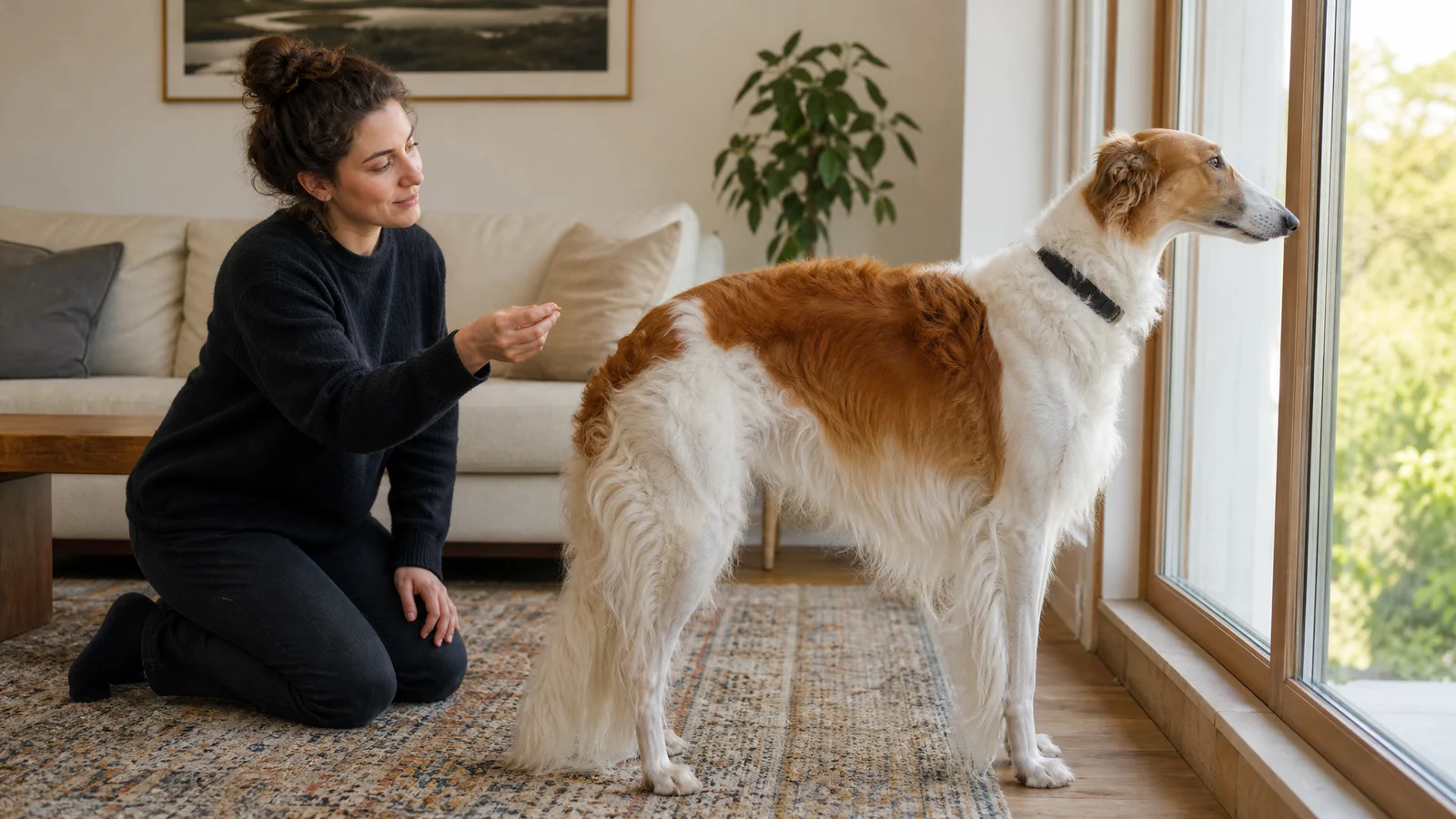
A sound fence fails if a door stands open. Teach a rewarded wait at every threshold. Rather than letting a dog rush up to visitors at the door, gate or boundary, the ASPCA suggests teaching them to go to a mat and settle there quietly until you invite them to say hello.
- Place a mat a few steps from the door. Reward the dog for lying on it while the door stays shut.
- Touch the handle, open the door a crack, close it. Reward for staying put.
- Open the door wider in small steps. The dog moves only after your release word, then gets a treat.
- Repeat at every gate and at the car door.
Add house rules for visitors. Tell guests the door stays shut until the dog is on the mat, in a crate or behind a baby gate. Most Borzoi grow to love their crate, which makes it a calm spot during arrivals. A new dog can also drag a leash indoors, and Best Friends suggests keeping a new dog on leash except in a fenced yard.
Wandering and Intact Males
Breed material links wandering to intact status. Neutered males are less likely to wander, and a lost intact male may be drawn to a female in season. That is a reason to tighten the fence, not a timing recommendation.
This is general information, not veterinary advice. Talk with your veterinarian about whether and when spaying or neutering suits your dog.
Collar Tags, Microchip or Tattoo for a Borzoi
Identification works in layers. A collar with tags lets any finder call you at once. A microchip or tattoo stays with the dog when a collar comes off. Use both, and register the microchip or tattoo with a pet recovery database. Pets with ID are also kept longer at shelters and are more likely to be treated by a vet.
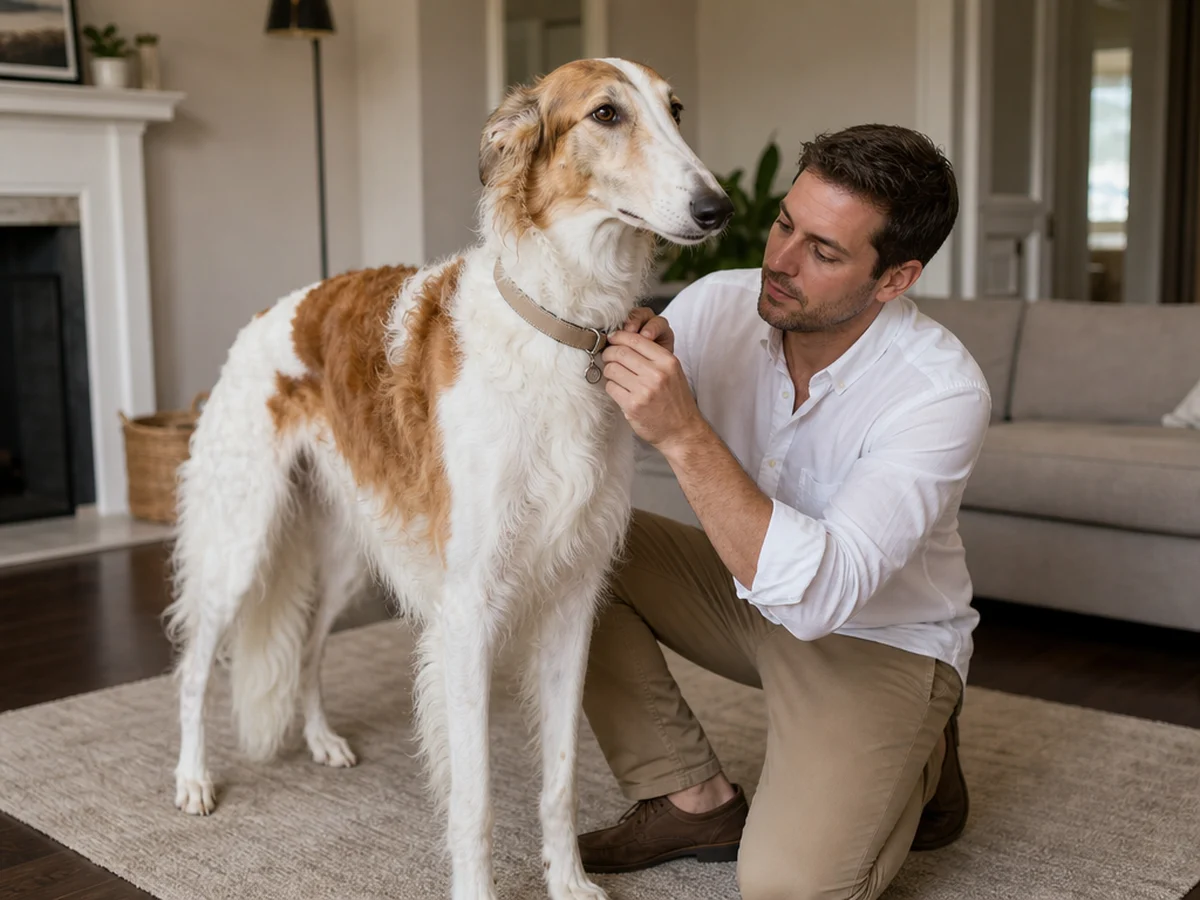
The table shows what each layer does and what you must keep current. Use the layers together rather than choosing one.
| Layer | What it does | What to keep current |
|---|---|---|
| Collar with license and ID tag | Lets a finder reach you immediately | Phone number, legible engraving |
| Microchip or tattoo | Permanent identification | Registry record with your address and phone |
| Temporary tag | Gives a travel or boarding address and destination | Add for each trip, update after |
| Breeder as second contact | Backup if you cannot be reached | Breeder's current number |
A chip with an old phone number is a chip that fails. Update the registry the same day you move or change numbers. Some breeders microchip or tattoo puppies before they leave and ask to stay on as a second contact, so keep that line open. At a regular vet visit, ask staff to scan the chip and confirm it reads.
Lost-Dog Photos to Keep Ready for Your Borzoi
Do this before anything goes wrong. Breed guidance says to take pictures and write a description of your dog's special characteristics in advance. During a search, you will not want to be hunting through a camera roll or trying to recall markings under stress.
Keep a favorites album with a full-body side view, a head shot from the front, close shots of any distinctive marks, and one photo of the dog wearing the everyday collar. Add a written note with coat color, markings, collar and tag details, and the chip or tattoo number. Share the album with everyone in the household.
These records do real work. Posters with a large photo, readable from a passing car, belong everywhere in a 20-block area, and a reward helps. A Borzoi rescue flyer can help shelters and vet clinics recognize a missing dog as a Borzoi. Notify every shelter in a wide radius and contact them every day, several times a day, in person if you can. People often keep a found animal for days or weeks before turning it in.
Why Recall Training Stays the Backup
Sighthounds are apt to chase anything that moves, so a Borzoi should always be in a fenced area or on a leash. Recall is the second line of defense. It helps when the fence has already done its job. It cannot replace the fence.
What Recall Can Do
Recall is excellent inside secure spaces. It brings the dog in from the far end of the yard, away from a gate and back from a door. Early training belongs in a secure area, or on a long line if you are anywhere else. Practice throughout the walk, not only at the end, so a call never means the fun is over. Pay well every time.
What Recall Cannot Do
Owners who trained recall from puppyhood still report it switching off when the dog sees an animal, even in a people-loving dog. Trust differs by individual and by line, and owners with dogs from coursing lines keep them leashed. Off-leash freedom outside a secure fence is not a realistic goal, because a dog who comes every time at home can ignore the call once something moves. Treat recall as a backup, not a license.
Cats add a twist. A Borzoi may be fine with the indoor cat and change dramatically outdoors when a cat, even theirs, runs. Owners report lunges at cats and wildlife strong enough to matter for equipment, so check buckles and hardware and consider a harness with a grab handle. Our guide to Borzoi prey drive goes deeper.
Training Habits for the Lost-Dog Kit
The lost-dog kit holds binoculars, a loud squeaker from a favorite toy, a pound of frozen gizzards, hearts and stew beef, and the dog's dog buddy. These work only if the dog already links them to good things. Teach that in advance, in small habits.
- Pair the squeaker with a treat in a quiet room. Squeak, then feed. Repeat over several short sessions.
- Move the same game into the fenced yard, then to larger spaces on a long line.
- Keep the squeaker rare. If it signals the end of fun, it loses its power.
- Let the strong-smelling food be the top reward in recall practice, so the smell alone means a payoff.
- Arrange regular good times with the dog buddy, with treats for both. A dog will come to another dog, and a trained dog called in may bring the lost dog following for treats.
- Keep the kit in a bag by the door and replace the food before it spoils.
If a dog does get out, start at once. Walk your neighborhood slowly, calling. Late evening or early morning may be best, when streets are quiet. Leave food and clothes or a blanket with your scent where the dog was last seen. Speed matters because Borzoi sometimes go feral very quickly, particularly in rural areas. Some are having fun and can feed themselves. Others want their owners once the thrill is over. Do not stop looking.
Car Rules and Wait Training for a Borzoi
Never leave a Borzoi in a car. Breed guidance says animals left in cars can escape or become overheated. Both risks are real for a tall dog, and neither depends on how long you plan to be gone.
A parked car is also open to anyone who walks past, and a dog alone has no one to stop a stranger opening a door. Make the car a rewarded-wait zone. Put the leash on before you open the door. Ask for a wait, release, then reward. When you travel or board, add a tag with your temporary address and destination.
Prevention First, Recall Training Second, for Borzoi Owners
The safety of your Borzoi must be your first priority. Put the toolkit in this order, and spend your effort in this order too.
- A secure fenced yard or enclosed kennel, with latched gates and managed doors.
- A collar with tags plus a microchip or tattoo, with current registry details.
- Photos and a written description, ready on every phone in the household.
- A leash or long line anywhere that is not secure.
- Recall as the backup, practiced in fenced spaces and rewarded well.
- A conditioned squeaker, dog buddy and kit, ready by the door.
Do one thing today. Walk the fence line, push on every board, test every latch, and fix the weakest spot. Then check that the tag and microchip details are current. Recall will never beat a sighthound's chase, but a fence that holds and a tag that works give you time and a way home.
 CareBorzoi Grooming: Brushing, Mats, Nails and Baths as Training
 BehaviorBorzois and Sudden Noises: Building Calm Confidence at Home
 Training basicsAre Borzois Easy to Train? Temperament and Trainability FAQ