 Borzoi

Yes, a scared Borzoi can learn to stay calm around sudden sounds. You get there by keeping the dog comfortable first, then pairing everyday noises with food and calm praise at a volume so low it barely registers.
The breed explains the jumpiness. Borzoi are sensitive, fast-reacting sighthounds built to notice movement and sound, so a slammed door lands as an event, not background. Handled badly, one bang turns into a dog who leaves the kitchen whenever a pan shifts. Handled well, you keep the companion cherished for a calm, agreeable temperament.
In this article, we'll go through why Borzoi startle so easily, a hypothetical adult in a row house, a week-by-week sound practice plan, and what to do in the moment a dog freezes or bolts. Borzoi behavior is what we specialize in, and the order of the steps matters more than the treats.
A Borzoi Startling at Sounds in a Row House
Everything below follows one typical household, and your own dog will move faster or slower. Picture an adopted adult Borzoi who has just arrived in a row house, where the shared wall carries every neighbor's door, footstep and television into the living room.
Most of the day this dog is gentle and quiet. A bang next door makes them jump, a metal lid on the tile makes them freeze, and a dropped pan sends them to the far end of the house, where they skip dinner. The new owners start by doing nothing clever.
They give the dog a few days to settle, and they use those days to write down what the house actually sounds like, because a surprise you cannot name is a surprise you cannot plan around. Here is their list, sorted by how the dog reacted.
| Sound in the Example | The Dog's Reaction | Place in the Plan |
|---|---|---|
| Refrigerator door, spoon in a bowl | A glance, then back to napping | First practice |
| Keys dropped on the counter | Ears swivel, brief pause | Early |
| Footsteps through the wall | Stops, stares, goes stiff | Middle |
| Pan lid set down on tile | Startles, slow to settle | Middle |
| Neighbor's door slamming | Bolts, skips dinner | Last |
The ranking follows the dog's reaction, not how loud a sound seems to you. A soft footstep through the wall can rattle a Borzoi more than a predictable vacuum. The best measuring stick is food. A dog who takes a treat soon after a sound is under their limit, and a dog who ignores the treat is over it. Some Borzoi also howl along to sirens, which is commentary, not panic, so note that separately.
Why a Borzoi Startles at Sudden Sounds so Easily
Start with the wiring. A sighthound notices every change in their surroundings, and the FCI standard pairs a calm temperament with a well evident visual response. Calm describes the dog on a good day. The same quick senses that spot movement across open ground also make a slammed door feel like news, and the reaction happens before any thinking does.
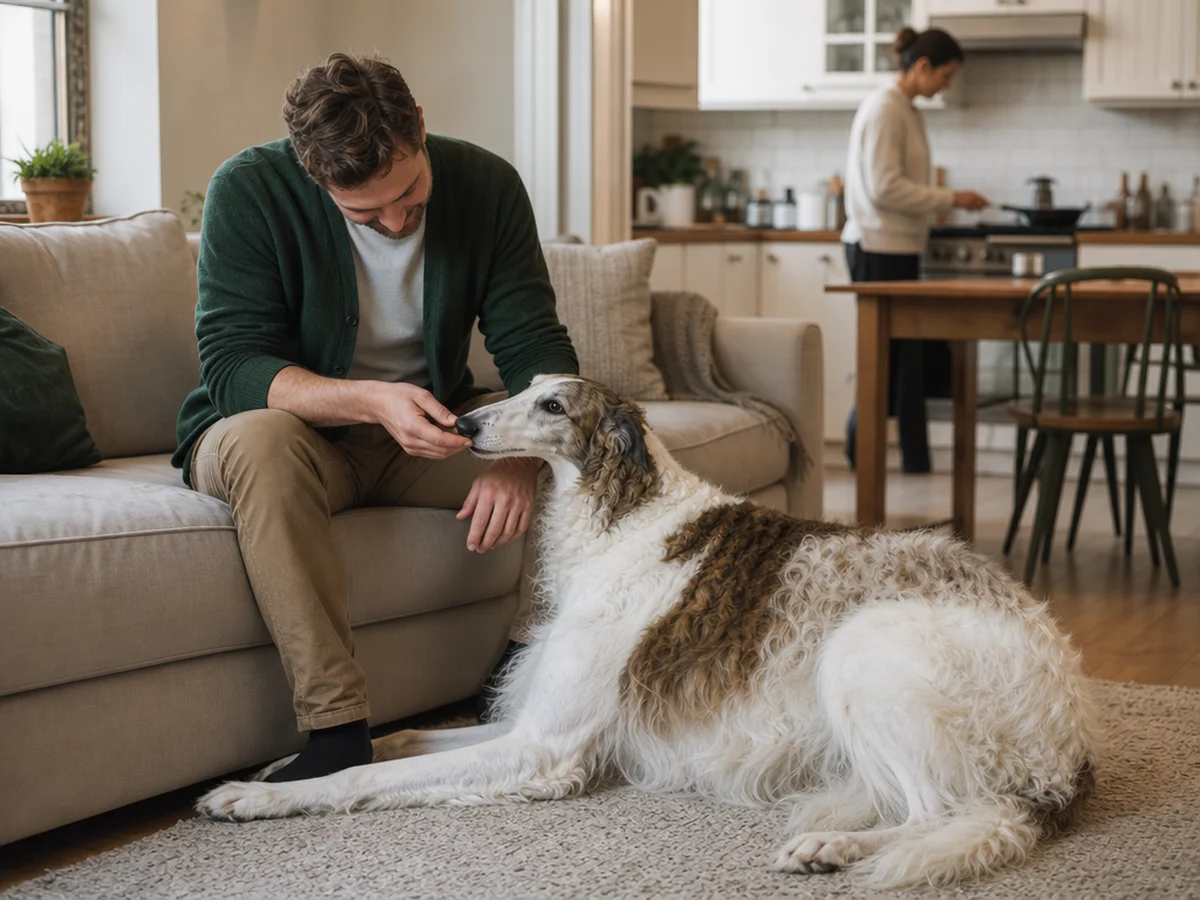
The startle usually takes one of two forms. Some Borzoi freeze, stiff and silent, as if waiting for the room to explain itself. Others bolt for the softest bed in the farthest room, and plenty of owners see both from the same dog on different days. Neither one is stubbornness or drama.
Two more breed traits matter here. Until a Borzoi has built trust through training, they are very curious about their surroundings, so every new noise gets inspected. And the dogs are sensitive and do better with positive methods. Many owners say their dogs do not forgive rough handling, so dragging a frightened dog up to the scary door to prove a point teaches them only that you are unpredictable too. Distance and food work. Confrontation does not.
One more point about temperament, since it trips people up. A Borzoi who startles is not under-socialized just because they are also aloof with strangers. Aloof is allowed in this breed, and a dog who is wary of a loud bang can still be a settled, affectionate companion at home.
Keeping a Startled Borzoi Comfortable First
The first stage of the example is not training. It is making sure the dog feels safe when a sound lands, because practice only works once they stop bracing for the next scare.
The retreat spot goes on a rug in the living room, away from the shared wall. It is a bed or mat the dog can reach without help, with a frozen stuffed toy parked on it. Many Borzoi want company on their own terms, in the same room but not on your lap, so a spot in the room beats a back bedroom. Our guide to settling a Borzoi indoors covers building the mat habit.
Nobody bothers the dog on that bed. It is where they recover, never a place they are sent. Next comes softer background noise. A low radio or a fan narrows the gap between quiet and bang, so the neighbor's door stands out less. The owners also dodge the loudest triggers for now, running the dishwasher while the dog is out on a walk and saving heavy cooking clatter for later.
When a sound lands anyway, the household sticks to a few plain moves. A predictable response keeps one scare from becoming a second problem:
- Stay calm and quiet. One low, easy word is plenty, with no baby talk and no scooping the dog up.
- Let the dog go where they want, and keep the path to the retreat spot clear.
- If the noise continues, add distance by walking toward the far end of the house together.
- Toss a treat near the bed only if the dog shows interest, since food pushed at a dog who is not ready just gets ignored.
Fussing over a startled Borzoi mostly teaches them there was something worth fussing about. Your calm is the lesson.
Food Pairing for Startling at Sudden Sounds
Week one in the example is the dullest week of the plan, which is the point. The order is the whole trick: sound first, then food. Food that appears before the sound is a bribe, while food after it is a prediction, and prediction is what the dog learns. Within days the refrigerator door starts to mean something good is on its way. A session runs like this:
- Pick a quiet sound from the top of the table, a calm moment and a dog who is a little hungry.
- Make the sound barely audible, or play a recording from a phone in another room at very low volume.
- A moment after the sound, say your marker word, hand over a tiny treat and add a few calm words of praise.
- Keep sessions to two to three minutes, several times a day, with a tossed toy between reps if the dog likes one.
- Stop on a good rep, before the dog has had enough.
The sign it is taking is small. The dog hears the sound, glances at the source, then looks at you for the treat. That look is the goal, because the sound now predicts food instead of danger. If they still flinch at the lowest level, the volume is still too high, so turn it down until you can barely hear it yourself.
Treat choice matters more than owners expect. Borzoi are surprisingly small eaters for a giant breed, so a so-so biscuit loses value fast. Use something special in tiny pieces and count them toward the day's food, since too many treats add weight. Rewards also shift with mood, and some Borzoi ignore thrown toys altogether, so keep a mix of food and play on hand.
Raising Sound Volume Slowly for a Borzoi
Over the following weeks, the example climbs two ladders, loudness and realism, and each gets its own turn. Because a sighthound notices every change, the parent club advises practicing with little distraction first and adding distractions slowly, only after the dog responds well at the current level.
Volume Before Realism
The recording goes up a small notch every few sessions, and only once the dog is looking for food at the current level. Then real objects arrive at low intensity: a pan lid set on a folded towel, a cabinet closed gently, a door pushed shut with a hand on it. Letting the dog sniff and touch the pan first helps, since a Borzoi who treats new things as something to explore is far less likely to treat them as threats.
Next comes location. Tile carries sound differently than carpet, so the same lid gets rerun in the kitchen, then the hallway, then near the shared wall. Later, a second person makes the noise while you feed. Only after a long run of that does a dropped pan, from a short height, make its debut.
Backing Off When the Dog Tenses
Stiffening is the signal to retreat. A freeze, a fixed stare at the source, turning away or refusing a treat all mean you asked for too much too fast. Return to the volume or distance that went fine, run a few easy reps and end the session there. There is no deadline, and the dog does not read the calendar.
Real life will still throw a bang at the dog between sessions. That is not a failure, just an unscheduled test. Use the comfort-first routine, then ask whether the next session needs to drop a notch. Scent work and agility are both known as confidence builders for a sensitive Borzoi, which makes them good side projects once the house is calmer.
Handling Startling at Sudden Sounds From Doors and Pans
The row house cannot be made silent, so the owners apply the same method to the sounds they cannot avoid. The idea is to keep the dog comfortable, then let every unavoidable noise become a signal that something good is coming.
For the neighbor's door, they keep a small pouch of very good treats within reach. When the bang comes, they say one calm, cheerful word and hand over food a moment after it, never before. The dog does not have to do anything. Sound, then food, is the whole lesson, and many owners find the dog starts glancing toward their person instead of freezing.
For the pan, the owners take charge of the sounds they cause. They lower dishes slowly, close cupboards gently and give a soft word of warning before the louder jobs. Then they practice dropping a lightweight item from a low height, at a distance, while the dog is relaxed on their bed, and they go back to an easier sound if the dog stiffens.
Outdoors, a truck door or a distant bang can send a big Borzoi swerving to the end of the leash. Some owners report lunges strong enough to break a harness buckle, so a snug, well-fitted harness is part of the setup, and our guide to leash training a Borzoi pairs well with everything above. On walks the method is the same: stand farther from the road, feed when a truck passes, then close the gap over time.
What to Do When a Borzoi Freezes or Bolts
Even with good practice, a scare will sometimes land before you can prepare. What you do in those few seconds matters more than any single session, and the best response is quieter than most people expect.
If Your Borzoi Freezes
A frozen dog is taking in information and deciding what to do. Stay still yourself, breathe out and speak in a low, ordinary voice. Do not crowd them, pull them toward the noise or pile on sympathy. The club's guidance is to give a startled dog distance and help them through it rather than make them face the scary thing. Once they soften, drop a treat near their feet and let them take their time.
If Your Borzoi Bolts
Do not chase. A Borzoi will outrun you anyway, and a chase can turn a scare into a bigger fright or a game. Walk calmly toward where they went, or sit and wait, and let them come back to the retreat spot. Many dogs head straight for the place that feels safest. During known noisy times, keep doors and gates closed so a bolting dog cannot reach the street.
Afterward, give them space, fresh water and a quiet few minutes. End the episode without drama, then think about what made the sound so large, so the next practice can be a little easier.
Progress After Startling at Sudden Sounds
After several weeks, the example dog still startles, and that is fine. Progress rarely looks like a dog who stops reacting. It looks like a dog who reacts and then recovers sooner, so judge the trend over weeks, not a single bad day. These are the signs the plan is paying off:
- The freeze gets shorter, shrinking from a long stare to a quick head turn.
- The dog takes a treat soon after a bang instead of leaving it on the floor.
- They glance at you after a sound instead of bolting, which means they are asking what to do instead of deciding alone.
- Their ears and body stay loose, and they walk back into the kitchen on their own soon after the noise.
Help for Startling at Sudden Sounds
Bring in help when the picture goes the other way. Look for a certified trainer who uses humane methods, and see our advice on choosing a Borzoi training class. These are the signs to ask a professional:
- Panic that does not fade, or fear that spreads to more and more sounds.
- Hiding for long stretches, or refusing food well after a sound.
- Attempts to escape through doors, gates or crates.
- A sudden change in an adult dog who was relaxed before.
Rule out the body, too. A sudden behavior change can be the first hint of a health problem when no frightening event explains it, because adult personalities tend to hold steady from around age 3. Pain can look a lot like fear. Keep up regular vet visits and mention any new noise sensitivity. Our page on calm vet visits and screenings covers what to expect.
A Borzoi is a sensitive, alert sighthound, so the whole plan runs on patience. Keep them comfortable first, let sound predict food at a volume they can handle, and raise the difficulty only as fast as they allow. A dog who learns that bangs come with snacks stays the calm, agreeable companion the breed is known for, and the dropped pan loses its power to wreck an evening.
 Training basicsAre Borzois Easy to Train? Temperament and Trainability FAQ
 Exercise and jobsLure Coursing as Training for a Borzoi
 Puppy trainingBorzoi Puppy Training Timeline: 8 Weeks to 2 Years