 Borzoi
Your Borzoi puppy sleeps all afternoon, a calm tangle of long legs. You open the crate, carry on with your day, and within minutes a puddle spreads across the kitchen floor that looks far too big for one puppy. Many owners describe exactly this scene.
What is going on is simple. A young bladder, a very large body and a puppy who has not yet linked the yard with relief add up to a big mess. Get the routine right and this stage fades into years of a clean, quiet house. Get it wrong and the favorite rug becomes the bathroom.
Below is the Borzoi-specific plan: the crate method, trip and reward timing around sleep, meals and play, adult adoption changes, and the patience a slow-maturing breed requires.
The Crate Is the Club's Potty Training Aid
Most puppies avoid soiling the spot where they sleep, and that instinct is why the crate anchors this plan. Breed guidance names the crate as a house-training aid, alongside travel, time home alone, unsupervised stretches and the teething stage. When you can't watch your puppy, a snug, den-like space makes the decision for them: wait, then go out the moment you open the door.
The breed makes this easier than most. Comfort in a crate is relatively easy to teach a Borzoi, and most grow to love the crate as their special home, even with the door left open. Many owners say their adults walk in and choose it without being asked. Count on that payoff from the first week.
One limit matters. A crate covers the stretches when you are out of sight for a little while, not a whole workday. For long absences, set up a crate indoors or an outdoor kennel run, and hand over a stuffed interactive toy so your puppy has something to do. Our Borzoi crate training guide covers time alone in depth.
Starting Borzoi Potty Training With the Crate Method
Set the crate up before your puppy walks in the door, then follow this order. A prepared space prevents rushed decisions.
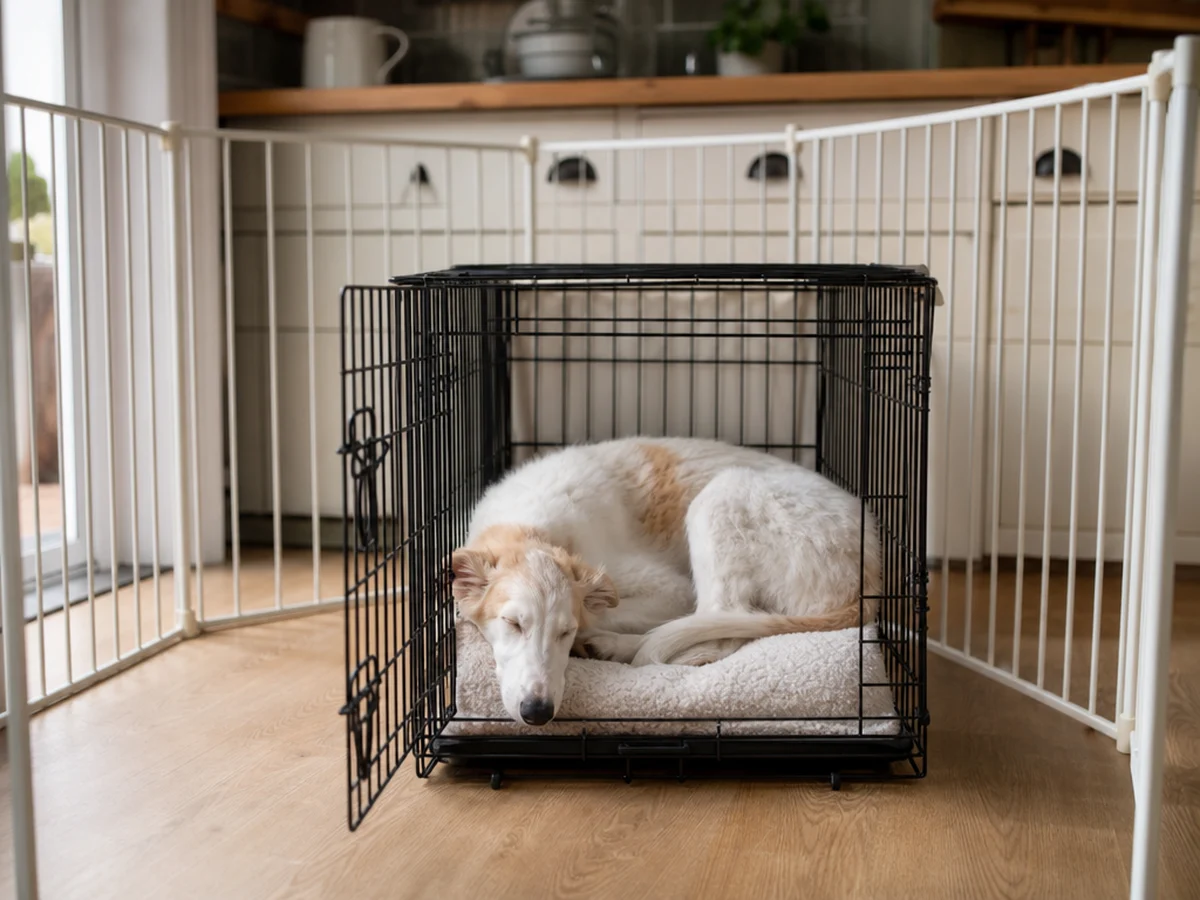
- Put the crate in the room where you spend the most time, with the door open.
- Place meals inside. As your puppy walks in, add a cue such as "crate" or "kennel up."
- Leave the door open for the first few days.
- Close the door only once your puppy goes in comfortably on their own.
- Offer a stuffed toy so the crate means something good is happening.
Never push or lift your puppy in. They must walk in by choice, and that choice is what makes the crate a haven and not a trap.
Skip the common advice to buy a small puppy crate and swap it later. The ideal crate for a grown Borzoi is 26 inches wide, 36 inches high and 48 inches long, so the dog can stand, turn around and lie down uncramped. A crate sized for an ordinary large breed will be too small.
Many owners buy the biggest crate they can from the start, move up to a 54-inch crate early, or have a kennel built for full adult size. Then use a divider, because a puppy with too much room sleeps at one end and eliminates at the other.
Some puppies cry the moment you leave their sight, and a few scream for a long stretch when left. Work on it with very short absences that you lengthen gradually. Some owners find a tall exercise pen suits their puppy better than a crate, so watch which setup your puppy settles in.
Scheduling Potty Training Around Sleep, Meals, and Play
Run your puppy's day by events, not by the clock alone. Go out the moment they wake, soon after each meal, right after play, and last thing at night. Young puppies need far more trips than grown dogs, sometimes every hour at first, since the muscles that control the bladder and bowel are immature. Puppies also eat more than adults while they grow fast, so expect plenty of output.
As a general rule of thumb, one hour per month of age works as a rough ceiling, so a 3-month-old may need a trip about every 3 hours. No Borzoi-specific figure exists, so let your puppy and a written record of meals, naps and trips set the pace. Plan on a quiet overnight trip if your puppy wakes and fusses.
Between trips, your puppy is in the crate or in your sight. Learn the signals that mean now:
- Sniffing the floor in a slow, searching loop.
- Circling or turning tight laps in one spot.
- Wandering away from you or from a toy.
- Play that stops abruptly.
When you see one, clip on the leash and head out. Keep every potty trip leashed, since a fast puppy who spots something moving can forget the job entirely. Our Borzoi leash training guide helps with the walk to the door.
Praise and Treats Belong at the Potty Spot
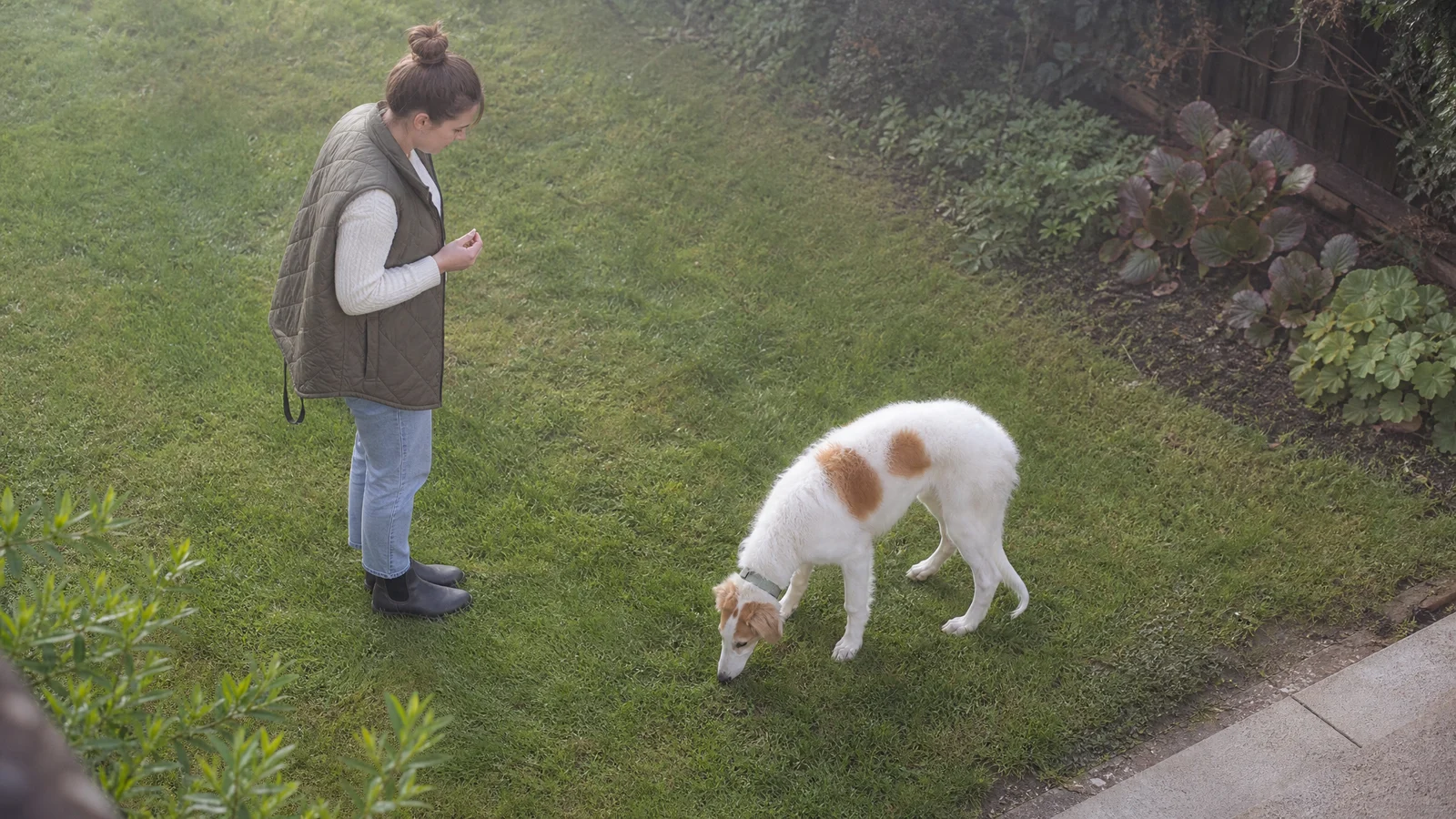
Hang a treat pouch beside the door you use, so the reward is always in reach. Walk to the same spot every time, stand still, and let your puppy sniff. Say one cue word, quietly, once, as they start. The instant they finish, deliver a treat and warm praise right there. A payoff that arrives after you walk back inside is too late to teach anything.
Make the reward match your puppy. Borzoi training works best when it is joyful and playful, and the breed's love of chasing a moving object can pay as well as food. After your puppy finishes, a few seconds with a toy dragged along the grass may beat a biscuit. Play comes after the job, never before it, or the trip turns into a game and the business gets forgotten.
Some owners find their puppy insists on carrying a toy to the spot on every trip. That is fine if the toy stays a prop until after the puppy has gone. Stay outside until you see it done, because a quick sniff and a dash for the door does not always mean the job is finished.
Accidents on a Borzoi's Scale Need Calm Cleanup
When the puddle appears, reach for towels, not your voice. A Borzoi puppy makes large messes, so stock old towels and a pet-safe enzymatic cleaner before you need them. Wash the spot well with the cleaner, which removes the odor that could draw your puppy back to it. Say nothing to your puppy. A puppy cannot connect a reaction to something that happened minutes earlier, and a nervous puppy may start sneaking behind furniture to go.
Should you spot your puppy mid-squat, keep your reaction calm and neutral, then walk them out on the leash. You cannot carry a growing Borzoi to the yard for long, so teach your puppy early to follow you to the door, and reward the walk. If they finish outside, reward that as you would any trip.
Then ask what went wrong. The answer is nearly always one of these:
- A trip came too late after a meal, nap or play session.
- You missed a signal because your puppy was out of sight.
- Your puppy had more freedom than their skills could handle.
Tighten the plan to fit. More frequent trips, closer watching and a smaller space fix most problems. If accidents arrive suddenly, or your puppy pees very often, strains, or goes in odd places, those can be signs of a bladder infection. Owners have also noticed a 3-month-old drinking and peeing about every hour. Call your vet in cases like these, and keep regular checkups on your calendar.
Potty Training Takes Months as Borzoi Mature Slowly
Plan the calendar before you plan the schedule. Borzoi are puppies for a long time. Sexual maturity typically arrives at 12 to 18 months, a bitch's first heat at 2 years or later is not uncommon, and physical maturity comes at about 2 years.
No source gives a Borzoi-specific house-training timeline, so measure progress by your own dog and expect months, not weeks. Some owners still see accidents at around 7 months, especially when the puppy is left alone, and that usually means freedom has outrun skill.
Pace that freedom one room at a time. Add a space only after a good run of accident-free days, and close it off again without drama if an accident follows. This table shows a sensible rhythm, and your puppy sets the real speed.
| Stage | Freedom | Focus |
|---|---|---|
| Around 3 months | Crate or the room you are in | Frequent trips, instant rewards |
| 4 to 5 months (teething) | Same rooms, no sudden expansion | Keep trips steady, pause intense training |
| Later puppyhood | One more room at a time | Longer gaps, short stretches alone |
| 12 to 18 months | Most of the house when you are home | Hold the routine as maturity arrives |
Teething deserves a warning of its own. Concentration may waver, and a task that seemed simple last week may be impossible this week. Put intense training on hold, keep socializing, and keep trips and rewards exactly as they were. Likewise, a leggy puppy who sits slowly or crookedly is growing, not defying you. Our Borzoi trainability FAQ explains why patience pays in this breed.
Reliable Potty Training Is a Habit Built Over Years
Expect reliability to arrive gradually, over months, and expect it to hold. A grown Borzoi who has been through this routine is a quiet, tidy housemate who walks to the door, goes where you taught them, and settles in a crate or bed they chose. Occasional slips can still appear during adolescence, when the body is changing fast. Meet them by returning to the early basics for a few days: more trips, closer watching, rewards at the spot.
Lapses nearly always have a reason. A move, a new work schedule, a houseguest or a new pet can each knock a routine sideways, and a sudden change that does not clear quickly is a reason to call your vet. Treat each one as a signal to tighten up, not as a sign you have failed.
Adopting an adult may spare you much of this, since older dogs have usually been through housebreaking and teething. Let them settle, then start with frequent trips and rewards until you see how they behave.
So think long term. Your Borzoi will take longer than many breeds to mature, and the early months ask for a crate built for the adult they will become, trips timed to sleep, meals and play, and rewards given at the spot. The dependable adult grows from the same routine you begin in the first week, and patience matters far more than speed. Keep it steady, and you get a clean, calm dog for the rest of their life.
 BehaviorBorzoi Prey Drive: Living With the Chase
 BehaviorIs the Dog Park Safe for a Borzoi? Chase Play and Gang-Ups
 Training basicsKeeping a Borzoi Safe: Fences, ID and a Lost-Dog Plan